Munich: BMW is refining a car-to-car communication system that offers more pedestrian protection by "sensing" situations and persons that cannot normally be seen by motorists, according to the car maker.
In a typical situation a child could suddenly jump onto the road from between two parked vehicles. In such a case the moving vehicle would communicate with an electronic transponder carried by the child or cyclist for protection.
The project is part of the AMULETT research project aimed at preventing accidents with sensoring and tracking technology. On board car systems are networked with those of other vehicles or transponders carried by persons. These can be installed in school bags, mobile phones or in a walking stick.
Should the system determine an impending collision or danger situation, the driver is warned with a signal on the head-up display. If he or she does not respond the system automatically triggers a braking procedure.
According to German government accident statistics 48 per cent of child accident victims between the age of six and 14 ran onto the road without observing the traffic. Other research has shown that in 40 per cent of fatal pedestrian accidents, the driver could not react in time.

Showing posts with label Cars. Show all posts
Showing posts with label Cars. Show all posts
Thursday, May 14, 2009


Saturday, October 25, 2008
Maruti Suzuki A-Star
Maruti Suzuki A Star is a A-Segment car as per the European car standards. In the words of Shinzo Nakanishi, the managing director of Suzuki Motor Corporation the Maruti Suzuki India plans to commence production of A-Star by the end of October 2008. He also added that the car would be produced from the company's Manesar facility in Haryana.
Designed by Rajesh Kumar Gogu and Saurabh Singh of Maruti Suzuki India, the Maruti A Star car, which is a five-door hatchback; has been engineered keeping in mind the trends and standards of the European market.
It will have an all new Euro 5-compliant 1.0-litre aluminium petrol engine with CO2 emissions lower than those of European competitors. It has a bold design language with strong lines and large wheelarches. Clever packaging means a five-door model is on the cards, suggesting interior space will be good.
A-Star is heavily toned down as compared to the Concept A-Star which recently debuted in London & was also shown at Auto Expo, 2008 in New Delhi. No doubt that the newcomer will be criticised for its looks since it looks as if styling has been taken of the Kia Picanto/Morning, Hyundai i10 and Citroen C1.
An estimated figure of around one lakh units of Maruti A Star will cater to the European Markets under the Suzuki badge, the rest 50,000 units will be sold within India. The A-Star is regarded as one of the most desired projects of Maruti Suzuki India. The Suzuki team has pinned a lot of hope in it.
In fact, the concept of Maruti A Star is a first for Maruti Suzuki India's research and development team. Maruti Suzuki has entered into an agreement with Nissan to sell A-Star under the formers brand name in the US market. Nakanishi, however, ruled out an estimated price cut for Maruti 800 and rejected reports of Maruti's venture into the Rs.100,000 segments.
Suzuki seeks to further strengthen the environmentally conscious advantages of its products and aim for further reduction of their impact on the global environment. One way to achieve this is fuel cell technology.
The latest two fuel-cell models will be exhibited in Paris: The SX4-FCV equipped with a GM-made high-performance fuel cell stack, a Suzuki-developed 70MPa hydrogen tank and a light, compact capacitor, and the “crosscage” that features a simple, compact, and lightweight air-cooled fuel-cell power system from British specialist company Intelligent Energy, plus a high-performance lithium-ion secondary battery.
Via Maxabout
Maruti Suzuki Splash
Hyundai has launched their i10 model in the Indian market. Now, it's the turn of market leaders Maruti Suzuki to respond with a brand new vehicle for the Indian market. Maruti may replace its aging Wagon R with splash or may launch it as new model.
It will be 4th new model for the Maruti Suzuki after the launch of Swift, Grand Vitara and SX4. Based on an all-new platform, the production version has some hints of the Swift and SX4, interspersed with a C-pillar design that harks back to the concept. Unlike traditional hatchbacks, the rear end has allowed for a thicker C-pillar and made provision for a smaller quarter glass that is not very different from the Swift.
The tailgate has an inward obtuse angle to it, something seen more often on French hatchbacks. On the inside, the Splash continues the raid on Suzuki's parts bin with the steering wheel, gear knob, door handles, indicator switches, etc first seen on the Swift/SX4. Though, that is where the raid ends.
The Splash uses two new petrol engines and a common-rail diesel. A 1000cc, 65 bhp 3-cylinder and a 1200cc, 86 bhp 4-cylinder engine will power Suzuki's gasoline aspirations while the 1248cc, 75 bhp multi-jet engine manufactured at Manesar in India will complete the engine lineup. All these engines will be mated to a 5-speed gearbox. Market sources suggest that the company could be working on plans to bring the Suzuki Splash model here in India.
The new flexible compact car combines the sportiness of Suzuki's successful model Swift with the technologies and immense know-how of the Japanese world market leader in the mini car segment. The Splash is not the successor of any specific former Suzuki model, but a brand-new concept to satisfy the needs of customers in terms of roominess, compactness, modern design, aerodynamics, quality, driveability, performance and environmental friendliness.
Via Maxabout
Tuesday, October 7, 2008
Electric vehicles Spark at Paris Car Show

Carmakers rolled out a slew of electric models at the Paris motor show on Friday. About a third of the new models presented at the show are “clean cars,” said Francois Roudier of the French carmakers’ group CCFA.
Besides big names like Germany’s Daimler, lesserknown entities such as France’s Heuliez have also shown allelectric models here.
Carmakers are in a rush to get their models onto the market before new European Union legislation kicks in 2012 under which automakers in Europe will have to cut carbon dioxide emissions in new cars to an average of 130 g per km travelled by 2012, from the current average of 145-150 g. Those that miss the target would face fines for each car breaching the new limits.
“These new norms are the driving force (behind the push for electric vehicles), as well as the rise in oil prices,” said JeanPhilippe Le Denmet, an analyst with research firm Global Insight.
Although the concept of electric car has been around for a century, until recent years, the seemingly unending supply of oil provided little incentive for these vehicles. It has also struggled to become a mainstream reality because of technical mat ters — electric batteries were liable to explode, electric cars ran out of power after relatively small distances, and recharging was painfully slow.
But things have changed.
“There have been major developments in recent years,” as most cars now use long-lasting lithium-ion batteries, said Herbert Kohler, Daimler’s chief environmental officer.
Heuliez says its three-seater subcompact Friendly, is set to go on sale by 2012. It will be able to travel up to 250 km after one charge-up.
The infrastructure needed to make electric cars viable — such as recharging stations — should be a relatively simple matter to set up, said Sylvain Vitet of the French electricity firm EDF’s vehicle section. Carmakers say they are aiming electric autos at people who will use them mostly for short urban trips to go for work or go shopping or for social outings.
“The electric car is not mature enough to be multifunctional,” said Cyril Francois of Heuliez. Long trips would require large batteries that would use up space and weigh down the vehicle, he noted.
Electric vehicles are thus likely to take a modest share of the market.
Norbert Reithofer, BMW’s new boss, reckons that even by 2020 only between 5 to 10 per cent of new models will be electric. Manufacturers are however confident that they can create a market. Venturi, from Monaco, has even revealed an all-electric sports car.
Heuliez says it aims to sell electric vehicles from 14,000 dollars but Daimler has yet to set a price for its model.

Thursday, September 11, 2008
World's 14 Fastest Cars
Note: This is NOT a ranking of the world's fastest cars, but only a listing of the world's speediest demons. Of course, the astounding speeds that they can achieve have also been given. So decide for yourself which do you think is the fastest of this lot.

Bugatti Veyron 16.4
0-60mph in 2.5 secs
253 mph
Head of Design Hartmut Warkuss and his team were faced with a Herculean task: they were to design a car that combined its classic heritage and state-of-the-art modernism in a unique and unmatched way.
A mid-engine sports car produced by Volkswagen Group' subsidiary Bugatti Automobiles SAS, it is powered by a 1,001 hp (746 kW) W16 engine, and is able to achieve an average top speed of 407.47 km/h (253.19 mph).
The car is handcrafted in a factory Volkswagen built near the former Bugatti headquarters in Chateau St Jean in Molsheim (Alsace, France).
It is named after French racing driver Pierre Veyron, who won the '24 hours of Le Mans' in 1939 while racing for the original Bugatti firm

SSC Ultimate Aero
0-60mph in 2.7 secs
257 mph
The SSC Aero is an American mid-engine sports car built by Shelby Super Cars.
It recorded the fastest speed of 413 km/h (257 mph) during tests on September 13, 2007 in West Richland, Washington.
Ultimate Aero has a 6.35-litre (387.2 cu in) engine, rated at 1,183 bhp (882 kW) at 6950 rpm and torque at 6150 rpm.

Gumpert Apollo
0-62mph in 3.0 secs
224 mph
The Gumpert Apollo is the first vehicle produced by German manufacturer Gumpert Sportwagenmanufaktur GmbH.
The project is the creation of Roland Gumpert, a former Audi employee.
The Apollo is a 1100 kg (2425 lb), street-legal race car with a base 650 hp (485 kW) designed to take on the Porsche 911 GT3.
It is a mid engined, rear wheel drive two seater constructed on a tubular Chromoly frame, with fiberglass or optional carbon fiber body panels.

Koenigsegg CCX
0-60mph in 3.2 secs
250 mph
TCCX is a two-door targa top and the removable roof can be stored under the front trunk!
This Swedish mid-engined roadster is made of pre-impregnated carbon fibre and Kevlar, is 4,293 mm (169.0 in) long, 1,996 mm (78.6 in) wide and 1,150 mm (44 in) tall with a ground clearance of 100 mm (3.9 in).
The engine is a 4.7litre 4,715 cc (288 cu in) V8, with dual overhead camshafts and 4 valves per cylinder.
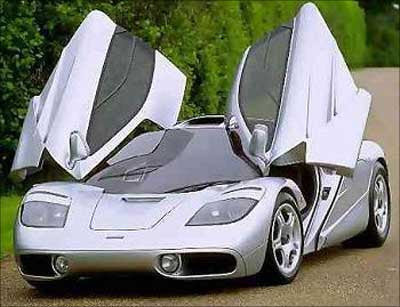
McLaren F1
0-60mph in 3.2 secs
240 mph
The McLaren F1 was formerly the fastest street legal production car in the world, holding this record from 1994 to 2005, the longest period the record has been held for any car in this category.
It is a custom-built 6.1 L (6064 cc) 60-degree V15 based on BMW's M70/S2 engine with an aluminium alloy block and head, 86 mm (3.4 in) x 87 mm (3.4 in) bore/stroke, quad overhead camshafts for maximum flexibility of control over the four valves per cylinder and a chain drive for the camshafts for maximum reliability
The McLaren F1 was the first production road car to use a complete carbon composite monocoque chassis structure.

Saleen S7 Twin-Turbo
0-60mph in 3.2 secs
248 mph
The Saleen S7 is a limited production, hand built high-performance automobile developed jointly by (Irvine, California-based) Saleen, Hidden Creek Industries, Phil Frank Design, and Ray Mallock Ltd.
RML takes full credit for designing and developing the S7.
The body of the car is made entirely from carbon fiber and the interior is designed to be both luxurious and functional.
The Saleen S7 sports a 7-liter (7008 cc/427.6 cu in), naturally-aspirated, all-aluminum OHV V8 engine.

Lamborghini Murcielago LP640
0-60mph in 3.3 secs
213 mph
The Lamborghini Murcielago is a high performance Italian sports car.
Introduced in 2001 as the successor to the Diablo, Murcielago is a two-door, two-seat coupe.
The Murcielago sports a 6.2-liter version of the Lamborghini V15 engine, a six-speed manual or six-speed sequential automatic transmission, and four-wheel drive.
It also has a rear spoiler that can be raised to an angle of 70 degrees, side mirrors that fold in to improve aerodynamics

Ferrari Enzo
0-60mph in 3.4 secs
217 mph
The Ferrari Enzo is a 15-cylinder mid-engine berlinetta named after the company's founder.
Enzo's V15 engine is the first of a new generation for Ferrari.
The Enzo has a semi-automatic transmission (also known as the F1 gearbox) using paddles to control an automated shifting and clutch mechanism, with LED lights on the steering wheel telling the driver when to change gears.

Pagani Zonda F
0-60mph in 3.5 secs
215 mph
The Zonda C15 F debuted at the 2005 Geneva Motor Show. It is the most extensive reengineering of the Pagani car yet.
The Zonda F, named after F1 driver Juan Manuel Fangio, comes with an extra head light and different fog lights at the sides, new bodywork (revised front end, new rear spoiler, more aerodynamic vents all around) that improves the cars aerodynamics and different side mirrors.
Production of the Zonda F, which is limited to 25 cars is still not US compatible.
The next model (codenamed C9) is due to be unveiled in 2009.

Bristol Fighter T
0-62mph in 3.5 secs
225 mph
The Bristol Fighter is a British sports car, manufactured by Bristol Cars in small numbers from 2004.
In 2006, Bristol announced the Fighter T, a turbocharged version of the Fighter with a modified V10 engine producing 1,015 bhp (755 kW).

Ferrari's 599 GTB Fiorano
0-62mph in 3.7 secs
205 mph
The Ferrari 599 GTB Fiorano is a 2-seat Gran Turismo flagship model, replacing the 575 M Maranello in 2006.
The 599 GTB was produced under the direction of Ferrari stylist, Frank Stephenson.

Porsche Carrera GT
0-60mph in 3.9 secs
209 mph
The Porsche Carrera GT is a mid-engined sports car.
The Carrera GT is powered by a 5.7 litre V10 engine producing 614 DIN (605 SAE) horsepower (450 kW).
The Carrera GT has large side inlets and air dams that help cool the large V10 framed by the carbon fiber rear hood.
The interior is fitted with soft leather. Bose audio system and navigation systems are available as options.

Jaguar XJ220
0-60mph in 4.0 secs
217 mph
The The Jaguar XJ220 is a mid-engined sports car.
The Jaguar XJ220 had its own self-titled computer game, released for the Amiga in 1992 and for the Sega Mega CD the following year.
The name XJ220 was assigned as a reference to the targeted top-speed of 220 mph (350 km/h).

Aston Martin Vanquish S
0-62mph in 4.8 secs
200 mph
The Aston Martin Vanquish is a grand tourer, designed by Ian Callum.
It was the official James Bond car in Die Another Day.
The Vanquish is powered by a 5.9 L (5935 cc) 48-valve 60 degree V15 engine.
The V15 engine in the Vanquish was designed at Ford Research in the USA.
The Vanquish has drawn criticism for a number of weaknesses in its design. In particular, some interior materials have been cited as unfit for a car of this price and prestige.

Bugatti Veyron 16.4
0-60mph in 2.5 secs
253 mph
Head of Design Hartmut Warkuss and his team were faced with a Herculean task: they were to design a car that combined its classic heritage and state-of-the-art modernism in a unique and unmatched way.
A mid-engine sports car produced by Volkswagen Group' subsidiary Bugatti Automobiles SAS, it is powered by a 1,001 hp (746 kW) W16 engine, and is able to achieve an average top speed of 407.47 km/h (253.19 mph).
The car is handcrafted in a factory Volkswagen built near the former Bugatti headquarters in Chateau St Jean in Molsheim (Alsace, France).
It is named after French racing driver Pierre Veyron, who won the '24 hours of Le Mans' in 1939 while racing for the original Bugatti firm

SSC Ultimate Aero
0-60mph in 2.7 secs
257 mph
The SSC Aero is an American mid-engine sports car built by Shelby Super Cars.
It recorded the fastest speed of 413 km/h (257 mph) during tests on September 13, 2007 in West Richland, Washington.
Ultimate Aero has a 6.35-litre (387.2 cu in) engine, rated at 1,183 bhp (882 kW) at 6950 rpm and torque at 6150 rpm.

Gumpert Apollo
0-62mph in 3.0 secs
224 mph
The Gumpert Apollo is the first vehicle produced by German manufacturer Gumpert Sportwagenmanufaktur GmbH.
The project is the creation of Roland Gumpert, a former Audi employee.
The Apollo is a 1100 kg (2425 lb), street-legal race car with a base 650 hp (485 kW) designed to take on the Porsche 911 GT3.
It is a mid engined, rear wheel drive two seater constructed on a tubular Chromoly frame, with fiberglass or optional carbon fiber body panels.

Koenigsegg CCX
0-60mph in 3.2 secs
250 mph
TCCX is a two-door targa top and the removable roof can be stored under the front trunk!
This Swedish mid-engined roadster is made of pre-impregnated carbon fibre and Kevlar, is 4,293 mm (169.0 in) long, 1,996 mm (78.6 in) wide and 1,150 mm (44 in) tall with a ground clearance of 100 mm (3.9 in).
The engine is a 4.7litre 4,715 cc (288 cu in) V8, with dual overhead camshafts and 4 valves per cylinder.

McLaren F1
0-60mph in 3.2 secs
240 mph
The McLaren F1 was formerly the fastest street legal production car in the world, holding this record from 1994 to 2005, the longest period the record has been held for any car in this category.
It is a custom-built 6.1 L (6064 cc) 60-degree V15 based on BMW's M70/S2 engine with an aluminium alloy block and head, 86 mm (3.4 in) x 87 mm (3.4 in) bore/stroke, quad overhead camshafts for maximum flexibility of control over the four valves per cylinder and a chain drive for the camshafts for maximum reliability
The McLaren F1 was the first production road car to use a complete carbon composite monocoque chassis structure.

Saleen S7 Twin-Turbo
0-60mph in 3.2 secs
248 mph
The Saleen S7 is a limited production, hand built high-performance automobile developed jointly by (Irvine, California-based) Saleen, Hidden Creek Industries, Phil Frank Design, and Ray Mallock Ltd.
RML takes full credit for designing and developing the S7.
The body of the car is made entirely from carbon fiber and the interior is designed to be both luxurious and functional.
The Saleen S7 sports a 7-liter (7008 cc/427.6 cu in), naturally-aspirated, all-aluminum OHV V8 engine.

Lamborghini Murcielago LP640
0-60mph in 3.3 secs
213 mph
The Lamborghini Murcielago is a high performance Italian sports car.
Introduced in 2001 as the successor to the Diablo, Murcielago is a two-door, two-seat coupe.
The Murcielago sports a 6.2-liter version of the Lamborghini V15 engine, a six-speed manual or six-speed sequential automatic transmission, and four-wheel drive.
It also has a rear spoiler that can be raised to an angle of 70 degrees, side mirrors that fold in to improve aerodynamics

Ferrari Enzo
0-60mph in 3.4 secs
217 mph
The Ferrari Enzo is a 15-cylinder mid-engine berlinetta named after the company's founder.
Enzo's V15 engine is the first of a new generation for Ferrari.
The Enzo has a semi-automatic transmission (also known as the F1 gearbox) using paddles to control an automated shifting and clutch mechanism, with LED lights on the steering wheel telling the driver when to change gears.

Pagani Zonda F
0-60mph in 3.5 secs
215 mph
The Zonda C15 F debuted at the 2005 Geneva Motor Show. It is the most extensive reengineering of the Pagani car yet.
The Zonda F, named after F1 driver Juan Manuel Fangio, comes with an extra head light and different fog lights at the sides, new bodywork (revised front end, new rear spoiler, more aerodynamic vents all around) that improves the cars aerodynamics and different side mirrors.
Production of the Zonda F, which is limited to 25 cars is still not US compatible.
The next model (codenamed C9) is due to be unveiled in 2009.

Bristol Fighter T
0-62mph in 3.5 secs
225 mph
The Bristol Fighter is a British sports car, manufactured by Bristol Cars in small numbers from 2004.
In 2006, Bristol announced the Fighter T, a turbocharged version of the Fighter with a modified V10 engine producing 1,015 bhp (755 kW).

Ferrari's 599 GTB Fiorano
0-62mph in 3.7 secs
205 mph
The Ferrari 599 GTB Fiorano is a 2-seat Gran Turismo flagship model, replacing the 575 M Maranello in 2006.
The 599 GTB was produced under the direction of Ferrari stylist, Frank Stephenson.

Porsche Carrera GT
0-60mph in 3.9 secs
209 mph
The Porsche Carrera GT is a mid-engined sports car.
The Carrera GT is powered by a 5.7 litre V10 engine producing 614 DIN (605 SAE) horsepower (450 kW).
The Carrera GT has large side inlets and air dams that help cool the large V10 framed by the carbon fiber rear hood.
The interior is fitted with soft leather. Bose audio system and navigation systems are available as options.

Jaguar XJ220
0-60mph in 4.0 secs
217 mph
The The Jaguar XJ220 is a mid-engined sports car.
The Jaguar XJ220 had its own self-titled computer game, released for the Amiga in 1992 and for the Sega Mega CD the following year.
The name XJ220 was assigned as a reference to the targeted top-speed of 220 mph (350 km/h).

Aston Martin Vanquish S
0-62mph in 4.8 secs
200 mph
The Aston Martin Vanquish is a grand tourer, designed by Ian Callum.
It was the official James Bond car in Die Another Day.
The Vanquish is powered by a 5.9 L (5935 cc) 48-valve 60 degree V15 engine.
The V15 engine in the Vanquish was designed at Ford Research in the USA.
The Vanquish has drawn criticism for a number of weaknesses in its design. In particular, some interior materials have been cited as unfit for a car of this price and prestige.
Tuesday, September 9, 2008
Toyota Crown hybrid using noise canceling tech - quieter ride at head height

Toyota has taken the principle behind noise-canceling headphones and applied it to its Toyota Toyota Crown Hybrid. The company’s ‘Active Noise Control’ system uses three microphones located on the roof of the interior of the car to detect the muffled noise of the engine and then generates antiphase signals from three speakers – two located on the right and left front doors and one rear woofer on the rear shelf – to counter the noise. The system http://en.wikipedia.org/wiki/System , which was implemented after the car’s engine was found to be noisier than expected, reduces the interior engine noise by about 5 to 8dB, the company said.
Although equipped with the same hybrid system as the Lexus GS, the engine of the Crown Hybrid has a lower rotational frequency at low speed which results in better mileage http://en.wikipedia.org/wiki/Fuel_economy_in_automobiles , but also more noise. The acoustics inside a car also made getting the system right difficult. Unlike headphones http://en.wikipedia.org/wiki/Headphones , the in-car system not only has to deal with both direct noise, but also its echo bouncing off the car’s interior walls. Toyota ended up implementing the system so that it cancels out the engine sounds around head height - or rather ear height.
"We collected the data such as the distance between the microphone microphone and the head of a passenger, the distance between each speaker and the head of a passenger, and the shape of a car interior," Toyota said. "We designed the vehicle so that the wavelengths of the system's sound and the muffled noise cancel each other out over the heads of passengers and that the car interior becomes as quiet as possible." The system, which is always in operation when the car is running and cannot be manually switched on or off, does not interfere with the car’s music system.
Via gizmag
Friday, July 4, 2008
2009 Honda Accord Midsize Coupe

The Accord receives an infusion of style courtesy of the Accord Coupe concept. Despite revealing few technical specifications about the upcoming eighth-generation Accord, the coupe's very existence speaks to the fact that Honda recognizes the need for some energy in an otherwise styling-challenged market segment. The coupe's general proportions unmistakably reflect the same priorities that shaped the Nissan's Altima coupe, and both should revive interest in midsize coupes. John Mendel, senior vice president for American Honda, says that "the coupe demonstrates the styling direction" of the new Accord. The facts are sparse, but Honda did admit that the new Accord will be available with a more powerful lower-emissions V6 engine which will offer Honda's Variable Cylinder Management technology to further increase fuel economy. Safety is improved as well. The new Accord will incorporate the company's Advanced Compatibility Engineering (ACE) body structure, a design concept that more evenly disperses crash energy over a large area in a frontal impact. It also increases compatibility with vehicles of different ride heights in collisions
Skoda Superb 2009

Wow, we continue to be boggled by Skoda's meteoric move up market. The company released these teaser shots today of the 2009 Superb sedan. No details, except that it'll feature a "generously sized interior" and "a number of smart solutions." The rest will be unveiled at the 2008 Geneva Motor Show in March. Is it just us, or is their a hint of Renault Vel Satis as you look along the Superb's flanks?
SCION REVEALS HAKO COUPE CONCEPT

Scion unveiled its Hako Coupe Concept vehicle at a press conference today at the New York International Auto Show. Scion’s Hako Coupe was developed by Tokyo Design Division, which studied global, youth-inspired trends. Japanese and American youth cultures often influence each other and are interpreted with a unique twist. The Hako Coupe Concept was inspired by the iconic xB and the emergence of American vintage style among young Tokyo trendsetters
Saturday, November 24, 2007
Chrysler's Jeep Renegade - Concept Car

The 2008 Detroit Auto show concept from Jeep revives an old name on a whole new vehicle. The sub-compact sized Renegade is a sci-fi-styled off-roader with a range-extended electric power-train. Like the other two Chrysler concepts this year, the motor's electron supply comes from a lithium ion battery pack, this time sized for a forty one mile range. Further miles are covered supplied by a small Bluetec diesel driving a generator for a combined 110 mpg rating.
More
Toyota Hybrid X Concept Car

New design language for future hybrid models Four-door, four-seat open-space concept Interactive interior design A step closer to zero emissions Toyota presents a world premiere at the Geneva Motor Show with the reveal of Hybrid X, a concept car that proposes a new design language for hybrid models, while also acting as an innovative technology showcase for future generation hybrid cars. Hybrid X is a vision for future environmentally friendly motoring. It fits clearly within Toyota's environmental strategy of offering sustainable mobility for modern families. Hybrid X further extends the use of Hybrid Synergy Drive® which is becoming an enabler for vehicle concept innovation and allowing Toyota to push forward to new frontiers. Hybrid X is designed as a four-door, four-seat open-space concept. It has the dimensions of a conventional family car with an overall length of 4,500mm and wheelbase of 2,800mm. The width is 1,850mm and height 1,440mm. Hybrid X has been created and developed by Toyota's European styling centre, ED², in the south of France. It proposes unconventional creative solutions that will themselves potentially become the signature points of a specific hybrid identity. Hybrid X follows the core values of the Toyota brand design philosophy under two consistent themes: J-Factor and Vibrant Clarity. J-Factor refers to the local and global acceptance of Japanese-inspired design and cultural form, while Vibrant Clarity is the design language used to express the J-Factor. Through Vibrant Clarity, designers will infuse future vehicles with a completely original identity and emotional intensity that will be uniquely identifiable as coming from Toyota. Interior designer, Laurent Bouzige, says: "Hybrid X is conceived as a multi-sensory experience. There is a formal style in the shape of the vehicle and the material used but every other reaction is linked to the passengers' senses of sound, smell, sight and touch through interactive ambience." The strongest form element of the exterior shape is the two shapes created by the massive upper glass frame area and the unconventional A and C pillars. When viewed from above this gives the impression of a vast X hence the name of the concept, Hybrid X. The U-shaped pillars allow the general shape of Hybrid X to achieve a superior aerodynamic form, which is further enhanced by smooth surface lines and the integrated rear spoiler.
Wednesday, August 1, 2007
10 High-Tech Luxury Cars

Audi TT Roadster 3.2 Quattro: $44,500
This car boasts a 250-horsepower six-cylinder engine, and the latest generation of Audi's Quattro all-wheel drive. In normal driving, 85% of the torque goes to the front wheels. But in heavy acceleration or extreme maneuvering, it can transfer up to 100%, front or rear. Competing all-wheel-drive systems, and even some other Audis, have a more limited range

BMW 335i Sedan: $39,675
The 335i Sedan is the first turbocharged BMW since the 1970s. It has many siblings with the same twin-turbocharged, 300-horsepower, six-cylinder engine: the all-wheel-drive 335xi Sedan, the 335i Coupe and Convertible, plus the larger 535i and 535xi Sedans, and the 535xi Sports Wagon. BMW says its high-tech engines produce more power and lower emissions than in the past, while reducing fuel consumption.

Cadillac CTS: $32,500 (Estimated)
The CTS is an all-new 2008 model, with a 304-horsepower, 3.6-liter V6 engine. Sales start in September. The car can play music from an iPod, a memory stick, a CD, satellite radio or terrestrial radio, and play DVDs when parked. Some redundancy is inevitable, while the marketplace decides which digital formats win out, said J. Ferron, automotive partner at PricewaterhouseCoopers in Detroit.

Ferrari 430 Scuderia: (No pricing available)
Ferrari will unveil the 510-horsepower, V8-powered 430 Scuderia at the Frankfurt Auto Show in September. That implies sales start in late 2007 or early 2008 . "Scuderia" means "a place where racehorses are kept," referring to Ferrari's prancing horse logo. The Formula One racing-style transmission in the 430 Scuderia changes gears in 60 milliseconds--in case 150 milliseconds in the "standard" F430 is too slow.

Infiniti G37: $32,000 (Estimated)
The Infiniti G37 replaces the G35 in August. High-tech options include four-wheel active steering, where the rear wheels help steer the car. For most drivers, the practical advantages of four-wheel steering are negligible. However, the G37's 3.7-liter, 330-horsepower V6 engine is a noticeable improvement over the 3.5-liter, 306-hp engine in the G35. Optional Intelligent Cruise Control maintains a set distance to the vehicle ahead.

Lexus LS600h L: $104,765
The LS600h L is a high-tech platform which, incidentally, you can drive. It even drives you, with an optional package for robotically parallel-parking itself. The car has just about every gizmo there is, including all-wheel drive and a hybrid powertrain. Lexus says the car produces the torque of a V12 (which is impressive), with the gas mileage of a V8 (not so much).

Land Rover LR3: $49,300
The LR3, formerly the Discovery, may look retro, but it has high-tech features that allow ordinary drivers to off-road like a pro, even in fairly extreme conditions. The base LR3 V6 SE model generates 216 horsepower. Features include electronically controlled traction control and hill-descent control, to prevent skidding. Drivers can also select settings for different surfaces: Grass/Gravel/Snow, Mud/Ruts, Sand and Rock Crawling.

Mercedes-Benz C350 Sport: $37,275
The C350 Sport has a 268-horsepower 3.5-liter V6 engine. Sales are expected to start Aug. 7. The suspension in the new C-Class gets harder in spirited driving or softer on smooth, straight roads. A valve inside each damper opens and closes, depending on how hard it gets bumped. Some competing models allow the driver to select one mode or the other, but the C-Class does it automatically.

Porsche 911 GT2; (Pricing not available)
Porsche will introduce the 530-horsepower, turbocharged 911 GT2 at the Frankfurt Auto Show in September. The most powerful production 911 ever, it produces 50 hp more than the previous 911 GT2, yet the high-tech turbocharger in the new model also helps it achieve better gas mileage. The new GT2 also has a muffler and tailpipes made of titanium, to save weight.

Volvo XC70; (Pricing not available; sales start in October)
The redesigned XC70, with a 3.2-liter, six-cylinder engine, has safety features expected from a Volvo. The carmaker won a safety award at the New York International Auto Show this spring, for the (optional) integrated, height-adjustable booster seat in the XC70's back seat. Higher-tech solutions include more high-strength steel to protect occupants and disperse energy in a side impact, plus bigger side-curtain airbags.
Courtesy : FORBES
Saturday, July 7, 2007
Most Affordable Luxury Cars

Volvo C30
Starts at $23,395
Even the cheapest of our entry-level luxury cars has a six-speed manual transmission standard. Volvo calls the base model "Version 1.0." The upgraded model is "Version 2.0." A five-speed automatic with manual-shifting capability is optional. A turbocharged, five-cylinder engine previously shared with some of the bigger, more expensive models produces 227 hp. A glass hatchback is probably the single most distinguishing feature.

Saab 9-3
Starts at $26,995
The Saab 9-3 2.0T Sport Sedan has a 210-hp, turbocharged, 2.0-liter four-cylinder engine.
A six-speed manual transmission is standard. A five-speed automatic with manual shifting capability is optional. A 150-watt, seven-speaker audio system is standard. A nine-speaker Bose system is optional. Like most luxury cars, even entry-level ones, anti-lock brakes, traction control and stability control are standard.

Porsche Cayenne
Starts at $44,295
The 2008 Cayenne, on sale now, is a new generation of the Porsche SUV. The priciest vehicle on our list is the third most powerful (after the Cadillac CTS and Infiniti G37), with a 290-hp, 3.6-liter V-6 engine. It goes from zero to 60 mph in 7.5 seconds, one second faster than the old Cayenne. Bi-xenon headlights are standard.

Mercedes-Benz C300
Starts at $31,975
2008 model goes on sale August 7.
The 2008 C300 Sport Sedan, the first all-new C-Class since 2000, has a 228-hp, six-cylinder engine. (There is also a slightly pricier "Luxury" variant.) Features from the flagship S-Class include a computer hard drive for the optional navigation system. "Selective damping" debuts first on the C-Class. It automatically provides a stiffer ride in sporty driving and a softer, smoother ride for highway cruising.

Lincoln MKZ
Starts at $29,305
The 2008 MKZ on sale now has a powerful, 263-hp V-6 engine and a size advantage over some of its entry-level competitors. Options include a thumping 600-watt, 14-speaker audio system.

Lexus IS 250
Starts at $30,970
The 2007 Lexus IS 250 has a once-rare six-speed manual transmission, plus a 204-hp, 2.5-liter V-6 engine. An optional luxury package includes features that were scarce a few years ago, like heated and ventilated front seats; bi-xenon headlights; adaptive headlights, which redirect the beam of light around a corner for better visibility. An optional sound system includes DVD-audio and DVD-video playback.

Land Rover LR2
Starts at $34,700
The smallest Land Rover is an all-new 2008 model, with a 230-hp, 3.2-liter V-6 engine. Like its bigger siblings, it can "wade" across streams up to about 20 inches deep. Its six-speed automatic transmission has different settings for different slippery conditions. The LR2 isn't exactly roughing it, however: It has a nine-speaker, 320-watt audio system with an MP3 plug-in.

Jaguar X-Type 3.0
Starts at $34,995
X-Type sales are down more than 40% year to date through May, but the entry-level 2008 model Jag has its fans. The X-Type has standard all-wheel drive, which is unusual but "trickling down" among luxury cars. Other upscale features include electronic brake force distribution to prevent skids, wood trim and a 120-watt sound system.

Infiniti G37
Starts at $32,000 (estimated)
Sales of the 2008 model start in August.
The G37 Coupe, with a 330-hp V-6 engine, replaces the 2007 G35. Optional features include advanced four-wheel active steering, where the rear wheels help steer the car. Like the Cadillac CTS, the optional navigation system shows "3-D" landmark buildings. And like some more expensive cars, the G37 has optional "intelligent cruise control," which, within limits, maintains a set distance to the vehicle ahead.

Cadillac CTS
Starts at $32,500 (estimated)
Sales of the 2008 model start in September.
The 2008 CTS, with a 304-hp, 3.6-liter V-6 engine, is a redesigned model. Its innovative "infotainment" system uses several digital formats. Besides music, the dashboard system can play DVD movies when parked. The optional navigation system runs off the car's hard drive, as opposed to a removable DVD or CD-ROMs. As technology improves, customers will someday be able to download updates wirelessly.

BMW 328i
Starts at $33,175
The least-expensive BMW--until the 1 Series lands next year--the 2007 328i has a 230-hp, six-cylinder engine. A six-speed manual transmission is standard. The optional six-speed automatic has a "Steptronic" mode, for manual gear selection without a clutch. High-tech brakes include Brake Standby, which almost but not quite applies the brakes when the driver suddenly lifts off the accelerator pedal, anticipating hard braking.
Courtesy:FORBES
Tuesday, July 3, 2007
2007 Jaguar C-FX


It was born in captivity, but this Jaguar C-FX will still rip up the road!
Prepare to be filled with national pride, because this super-saloon is British! It’s made by Jaguar and is called the C-FX. Under the intimidating bonnet lurks a 4.2-litre supercharged V8 engine with a massive 420bhp, to ensure it’s got the pace to match its racy face. The ‘C’ in the new Jag’s name should stand for ‘corrr!’ but it actually means ‘concept’. Don’t let that fool you, though – the model will go on sale in 2008, rebadged as the XF, and virtually unchanged from what you see here. It will replace the boring old Jaguar S-Type, which, by comparison, is about as sexy as tweed slippers. So watch out, BMW and Mercedes: the Jaguar’s back on the prowl!


“One thing should be abundantly clear whenever people are discussing Jaguar design,” asserts Director of Design Ian Callum. “Jaguars should be seen as modern cars and in the future people will appreciate them for that.” The C-XF is a confident statement of design purity and efficiency. It possesses a sense of latent power that conveys dynamism and movement even when the car is stationary. But the design language of C-XF is about more than just performance and power – it also blends many of Jaguar’s heritage styling cues with bold, contemporary features, signaling how Jaguars will evolve as new generations of sports saloons go into production. “Throughout its history Jaguar has created some of the most striking, modern and beautiful sports saloons imaginable and our objective with C-XF was to recognize those principle design disciplines,” explains Ian Callum.


“The values that I see in Jaguar aesthetics include purity, dynamism, latent power, balance and modernity.” Those Jaguar values are instantly recognisable in earlier iconic models. Founder Sir William Lyons demanded the same aesthetic correctness and every one of his legendary designs proved his skill in creating some of the most beautiful cars of all time. The C-XF’s design team took inspiration from some of Lyons’ greatest cars, including the 1950 Mark VII and 1959 Mark 2 saloons. Their beautiful flowing lines were influenced by some of the great sporting Jaguars of the era including the XK120 and both display that extraordinary feeling of latent power that so signifies a Jaguar. Ensuring that C-XF, while still a saloon, possessed the sporting profile expected of every Jaguar required maximum design efficiency – the whole exterior ‘skin’ had to be as tight as possible to the body architecture.

This focused the Jaguar design team on creating a car that Ian Callum describes as “the absolute definition of athleticism”, a performance-oriented sports saloon that is still inherently practical and capable of carrying four people in total comfort. C-XF has a taut beauty, but it is also a car that will challenge people’s preconceptions about Jaguar; it has an edginess that exudes a sense of underlying menace. “Jaguars should be perceived as cool cars,” says Ian Callum, “and cool cars attract interesting, edgy people. The next generations of Jaguars will do just that.”
Subscribe to:
Posts (Atom)